Guqin (古琴)
The guqin speaks in silence as much as in sound — seven strings stretched across three thousand years of solitude, philosophy, and longing. Traditional compositions and modern arrangements rendered on silk and wood.
Piano
Studied guqin under Mingmei Yip, guqin artist and professor at the US-China Music Institute at Bard College. Of all the instruments, the guqin is the one the ancients played for themselves — not to entertain, but to cultivate. Its sound is spare, its silences deliberate. The performances below are my own — compositions old and new, each an attempt to listen as much as to play.
Attributed to Ruan Ji, one of the Seven Sages of the Bamboo Grove — a group of scholars who withdrew from court life during the Wei-Jin period. The title translates to 'Wine Madness.' Ruan Ji reportedly drank to escape the political dangers of his time. The earliest surviving tablature, 《神奇秘谱》(1425), asks: 岂真嗜酒耶,有道存焉 — 'Is he truly fond of wine? There is Dao within it.'
An old soldier sings to the son who will not return. This melody from Avatar: The Last Airbender carries a grief that needs no translation — rendered here on guqin, where each note is given room to ache, and the spaces between them say what words cannot.
Guqin notation (减字谱, jiǎnzìpǔ) is a descriptive tablature — each composite character encodes which finger, which string, and where along its length to press, producing specific pitches through position rather than abstract symbols. Rhythm and expression are left to the player's interpretation. This transcription was arranged and calligraphed by hand.
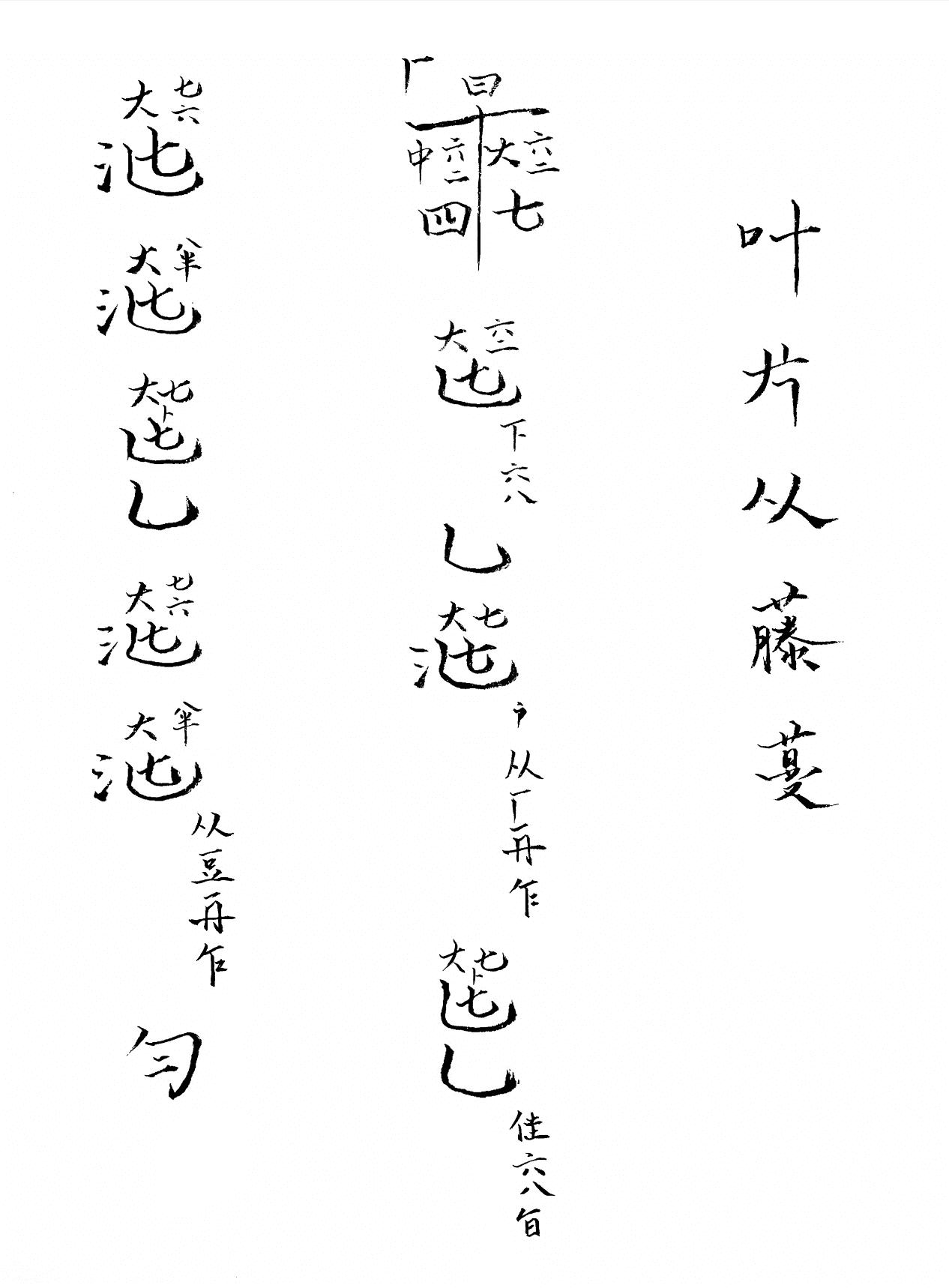
What happens when you strip a pop song down to seven strings and three thousand years of aesthetic philosophy? The longing in Billie Eilish's voice translates surprisingly well to an instrument built for solitude. These arrangements of "i love you" and "idontwannabeyouanymore" let the guqin do what it has always done — hold an emotion still long enough to look at it.
Debussy once said that 'music is the silence between the notes.' This concept has long been integral to guqin music — an instrument of three voices: open strings (散音), harmonics (泛音), and stopped notes (按音), each separated by silence. The Yushan school named four qualities of qin sound: 清 pure, 微 profound, 淡 light, 遠 distant.
There is a technique unique to the guqin: in nao (猱), the left hand continues to slide along the string even after the sound has disappeared. You are playing, but there is nothing to hear — only fingers on silk. You and the listener complete the rest. This is Laozi's 大音希声 — the great sound is rarely heard (Dao De Jing, 41).
Clair de lune breathes the same way — the feeling lands not in the sound but in the silence after. Cage made it visible with 4'33". The qin tradition calls it 無聲之樂 — the music without sound.
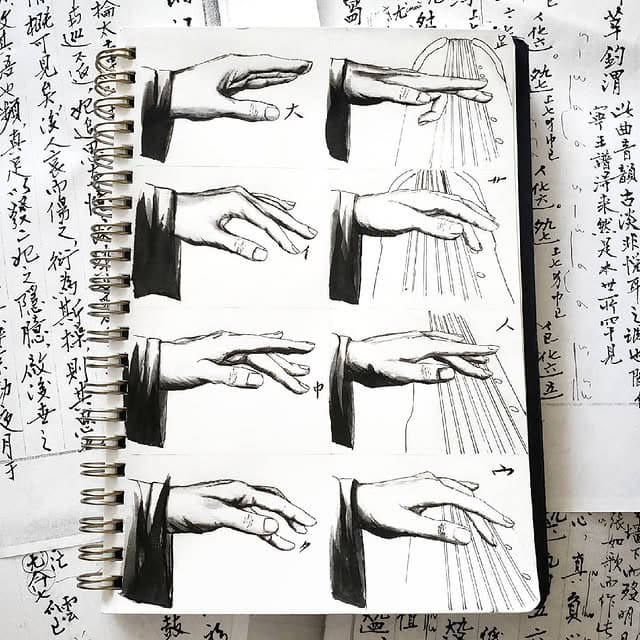
To play the guqin is to learn its body — the way fingers meet silk, the angles of touch that conjure harmonics from wood. This study led naturally to brush and ink, documenting the gestures that make the instrument sing.
Piano